After wrapping up long projects at work our management likes to hold “lessons learned” sessions in which employees are encouraged to share bits of knowledge we gained that might make the next project go more smoothly. I’ll never forget the time a coworker of mine, after a particularly grueling project came to an end, stood up in one of those meetings and offered the following advice: “the lesson I learned is that we don’t learn our lesson!”
If there’s one thing anyone associated with the Jurassic Park franchise should know by now it’s that greed never pays. Jurassic World: Rebirth begins with a drug company hiring a mercenary for a secret mission. The company has discovered dinosaur hearts contain a chemical that could be turned into a drug to essentially eliminate heart disease in people. After it is established that the only way to extract this solution is to travel to the equator, get within 10 meters of the largest land, sea, and flying dinosaurs, and shoot them with a gun-powered needle, a stereotypical team is assembled: a mercenary, a local security guy with a boat, a scientist, the head of the drug company, and some two-legged dinosaur food. On their way to the island, the team rescures the crew of a capsized sailboat which adds a few kids and teans into the mix.
It is soon revealed that the island the team has landed on was used by the original Jurassic Park scientist to create genetically-modified dinosaurs, and the worst of the worst were dumped here. If you’re wondering “what could possibly go wrong,” the answer of course is “everything.”
1993’s Jurassic Park contained ground-breaking special effects, which makes it hard to top. 22 years later, the dinosaurs here look essentially the same and the magic of seeing them for the first time is gone. In I can only assume was a decision by marketing to sell new toys, all the dinosaurs in this film are mutations and new which means the team is in pursuit of a (I had to look this up) Titanosaurus, Quetzalcoatlus, and Mosasaurus. Fortunately, they all look pretty much like dinosaurs we already know. There’s also a tiny dino that attaches itself to the group and sounds suspiciously like an Ewok; I can only assume a game based on it has already been developed and is waiting to launch.
The only actor I recognized in the film was Scarlet Johansson, who plays Zora the mercenary. The other lead roles are played by Mahershala Ali, Johnathan Bailer, and Rupert Friend. Maybe those names mean something to you.
Jurassic World: Rebirth is a summer action flick. Most of the characters make dumb decisions, there are leaps of faith in the plot a jumping jumpasaurus couldn’t cover, and plenty of dinosaur madness. Check your brain at the door lest a T-Rex eat it and enjoy the show.
Stop me if you’ve heard this plot before: a kid and his single mother move to a new town where the kid meets a girl whose ex-boyfriend is a student of karate who beats the kid up for pursuing his ex, who he wants to get back together with. The boy eventually trains under an old Asian man to better his skills so he can take on the ex-boyfriend in a large tournament. Not only is this the plot to 1984’s Karate Kid, but also the plot to the 2025 film Karate Kid: Legends.
Of course, this sequel which takes place a year after the end of Cobra Kai adds a lot of new twists. Li Fong, the boy who moves from Hong Kong to New York City, is already well trained in Kung-Fu, thanks to having a pretty good uncle for a teacher — Mr. Han, played by Jackie Chan. The girl Fong meets in New York City is Mia, and the film’s major subplot involves her father, Victor, who is a retired boxer who owes a lot of money to a local loan shark, who also happens the own the local “bad guy” dojo. You can tell they’re the bad guys because everyone is wearing black, and our antagonist has a cheesy looking ponytail. Victor asks Fong to train him to be hit faster and harder in hopes of winning money to pay off his loans by reentering the ring (which he does, with disastrous results).
We learn early on that Fong has made a promise to give up fighting after his brother was stabbed to death after winning a tournament (yikes). Of course this is a Karate Kid movie and despite his promise Fong fights every single day. When it becomes obvious all roads are leading Fong to enter the Five Burroughs Karate Tournament to face Conor, conquer his own demons, and win the $50,000 purse so he can give it to a washed up boxer he just met, Mr. Han shows up just in time to assist with training. Unfortunately being a master of Kung-Fu is not going to be enough to win this tournament and so Mr. Han reaches out to the student of his old friend Mr. Miyagi, the one and only Daniel LaRusso. Togther, Mr. Han and Daniel-San teach Fong all their techniques by beating him to a pulp.
Before you know it, everything is wrapped up. Karate Kid: Legends has a run time of 94 minutes, despite adding in multiple more layers than the original which was more than 30 minutes longer with a run time of 126 minutes. At times Karate Kid: Legends feels more like a videogame or music video than an actual film, with lots of on-screen text and graphics popping up. No one is given time to contemplate or think or even breathe; every pause has been removed from the film. The death of Fong’s brother is explained in a fifteen-second flashback. Mr. Han convinces Daniel (someone he has never met) to drop what he’s doing in California, fly to New York City, and train a kid he’s never met because Mr. Han knew Mr. Miyagi in less than five minutes of screen time. The film wants to be a rollercoaster but at this pace it’s more like a bullet train.
While Karate Kid: Legends isn’t bad it’s far from the classic the original was. Fans of Cobra Kai will enjoy the continuation of the story and this new intertwining of the two previously separate franchises. Despite being older, Jackie Chan still shines in his role and his fingerprints are all over every single fight scene in the film. It wouldn’t surprise me to see a director’s cut of this film in a few months that adds another half hour back into the film as pivotal scenes like repaying the loan shark and an inevitable setup between the owner of the dojo and Mr. Han and/or Daniel are nowhere to be found.
Karate Kid: Legends moves as quickly as one of Jackie Chan’s kicks, but is nowhere as deep as his filmography.
A gift (or perhaps curse) of mine is that I can usually see both sides of every argument. A lot of critics are claiming the 2024 remake of Nosferatu as a real piece of art, while some articles were reporting a 25% walkout rate. I just finished watching the film and… well, I can see both sides.
If you’ve seen the original, silent version of Nosferatu you already know the plot and even if you haven’t, you essentially know the story from watching Dracula. The plot is streamlined and simple: Thomas Hutter (Nicholas Hoult) is asked by his real estate employer to travel to the Carpathian Mountains and escort rich but eccentric client Count Orlok (Bill Skarsgard) back to England. Hoult’s wife Ellen (Lily-Rose Depp) has been having nightmares about the trip and begs her husband not to go, but the money’s too good to refuse and so he goes. The trip is difficult but Thomas eventually meets with Count Orlok and escorts him back; little does he know, Orlok has his creepy eyes set on Helen whom, if he can convince her to give herself willing to him, his curse will be broken. I think. In the middle of all this, Prof. Albin Everhart von Franz (Willem Dafoe) is busy trying to figure out what is causing people to become seemingly possessed, while the rest of us are trying to figure out why his name isn’t Van Helsing.
To the people who loved it, I get it. To me this felt almost like an old Hammer film, made in 2024. It’s super stylized — maybe as a nod to the old “colored gel” versions of Nosferatu I’ve seen, 2/3 of the movie is done in blues while the other 1/3 is done in oranges (sunset and sunrise?). The costumes are great and the sets are astounding. Everyone speaks like it’s the 1800s London so accents are thick but true. Count Orlok sounds and looks creepy. The whole thing is super gothy.
To those that walked out… I kind of get that, too. I can’t imagine a single person under the age of 20 or maybe even 30 having the patience to sit through this film. It’s slow. Sometimes, there are subtitles. It’s moody. Nobody turns into a bat. There aren’t really any action scenes, save for a couple of stakes being driven into appropriate chest chambers. It’s such a atmospheric film that I could see the experience being ruined by a single cell phone going off.
When I was a kid and someone mentioned “vampire” I guess I thought of Dracula first and the Lost Boys second, and I’m not sure what a kid’s point of reference is today. In this film, Count Orlok isn’t just creepy like he appears in the original — he’s literally rotten, covered in open sores and ugly and also has a silly moustache. He’s also one of the most powerful vampire I’ve seen. This guy isn’t tricking people eating rice into thinking they’re maggots — he’s sending people into violent seizures hundreds of miles away and infecting everyone’s dreams — no need to stare into this guy’s eyes to get hypnotized.
Overall I enjoyed the film, but you gotta know what you’re walking into. It’s an over-the-top gothfest that takes itself maybe a little too seriously. It’s a slow burn vampire film with more stylistic cuts to black and back than I could “Count”. Film students are going to love it but I’m not sure horror fans will be rewatching it too many times.
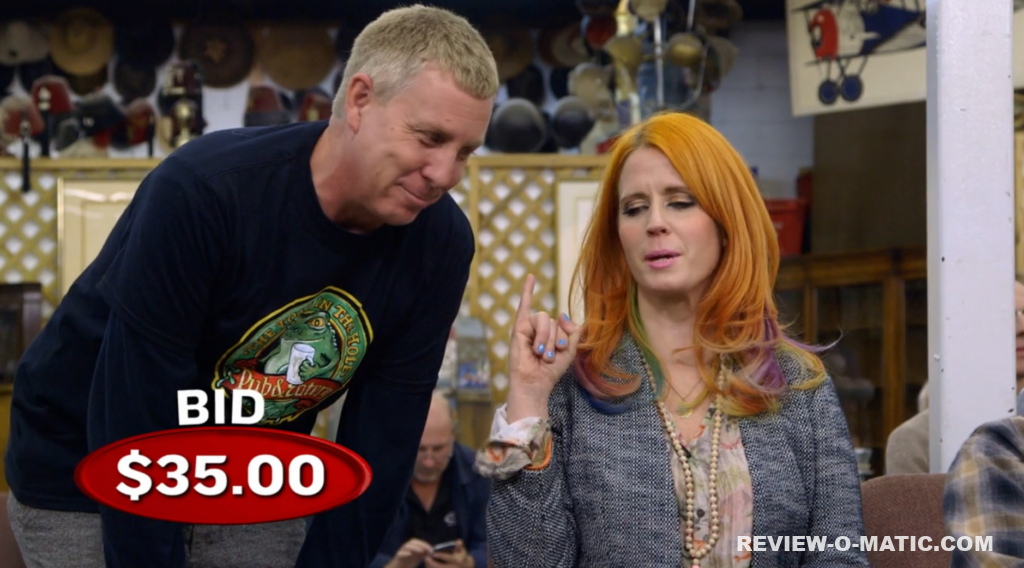
In the Canadian reality show Buy It, Fix It, Sell It, a small pool of competitors compete against one another by buying items at an auction, reimagining those purchases into art pieces, and then selling them. Whomever makes the biggest profit off their purchase is declared the winner, although somewhere along the way reality gets thrown aside in the name of entertainment.
Like most reality shows, each episode of the show follows an identical format. Three of the show’s four artists attend the same auction and bid on items they hope to turn into expensive art projects and sell for a profit. The show is very formulaic. Every artist tries to sell their items high, the buyers lowball them, someone says “let’s meet in the middle,” and then they do.
The show’s four competitors are Willy, Bob, Tiffany, and brothers Mike and Joe (known collectively as “the Neon Brothers”). Each has their own style and never shall they deviate from it. Tiffany is the wacky artist with orange, pink, and purple hair who turns everything into over the top art pieces. The Neon Brothers buy things, fix them up, and add neon to them. Then there’s Willy, an artist who’s also a biker, and Bob, an artist who’s also a hot rod guy.
Reality shows like this have two main draws. The first is watching the process of taking something normal and turning it into something else. The other is seeing how much profit can be made by selling such pieces of art. Somehow, Buy It, Fix It, Sell It manages to mess up both of those things.
Shows like Flea Market Flip show audiences the work that goes into converting regular items into over the top art pieces. On Buy It, Fix It, Sell It, all the work takes place off screen. In almost every episode, items magically change from broken down pieces of junk to expensive pieces of art during the commercial break. Very rarely do we see nails driven or paint being applied. In one episode Bob buys an old motorcycle for $350 and after the commercial break the entire thing has been disassembled, sandblasted, painted gold, turned into a drink dispenser, and reassembled. The Neon Brothers purchase an ugly coffee table and by the time we return from the commercial break it’s been turned into a fancy headboard complete with fabric, a custom sign, and lots of course, lots of neon.
What’s more ridiculous is the fact that the parts they add to the items they sell aren’t included in the overall cost. In another episode, Tiffany purchases a leather suitcase for $170 and, when she finds herself short on time, outsources it to someone else (again off screen) to upgrade. The next time we see it, it’s been converted into a coffee table complete with a glass top, a stained pallet bottom, and fancy metal castors. Tiffany attempts to sell it for $800 but is only able to get $200 for it, which we’re told is a profit of $30. Tiffany apparently has people on speed dial who will contribute materials and put dozens of hours into a project for free. Actually, everyone on the show does. None of the parts and none of the labor costs anyone anything. What a world!
Perhaps the least realistic part about the reality show is the selling process. Each item is delivered to the client’s house or space… and then the negotiations begin. In on episode, Tiffany does to a client’s cafe and — while the owner is away — spends an entire weekend gluing and screwing books to a wall in a custom art installation. Then the owner returns, again after days of work, and negotiations begin. I’m no expert when it comes to selling artwork, but I’m pretty sure permanently installing it before discussing a price puts you at an extreme disadvantage when it comes to negotiations.
With so many reasons not to watch this show… I must confess, I binged the entire show — all 20 or so episodes. At the end of the day, the hosts are really charismatic and likeable. If they made more episodes, I’d watch every single one of them… and complain the entire time.
Buy It, Fix It, Sell It is currently available to stream for free on Tubi.
Link: Buy It, Fix It, Sell It (Tubtv.com)
There are certain things I expect from a films like Super Ninja. I expect battles between ninjas, hopefully involving a variety of ninja weapons. I expect quick cuts, music cues pilfered from other film soundtracks, and terrible dubbing. True to form, Super Ninja delivers all of this like a sharp punch to the jaw. The thing I wouldn’t demand or even expect is a comprehensible plot. I’ve seen more of these films than ninjas have throwing stars, and the plots are often convoluted and frequently incomprehensible, often from dicing and splicing random films together, that seeing characters disappear while new ones appear in completely different locations is not uncommon. It’s almost expected. This is where Super Ninja sneaks in a surprise, like a ninja in the night.
The film opens with an epic ninja battle which ultimately cuts to a gang attack which is broken up by officers John and Spencer who also happen to be trained in the martial arts. A member of the gang has ties of an elected official, and soon John finds himself the target of a corrupt police investigation. John’s girlfriend Nancy gets trapped in the crossfire as John is arrested and tortured by fellow officers, determined to discover just how much he knows about the drug traffickers. There’s a subplot involving Nancy and her father, a scientist, who has come up with a drug. I didn’t say the plot was award worthy, but it’s followable.
A pleasant surprise for me (but not anyone who’s seen the trailer) was the arrival of the Five Elemental Ninjas, brightly colored ninjas from the film of the same name. With suits and supernatural skills that match the elements, like water and fire. The Elemental Ninjas are a force to be reckoned with and add over the top action to the film.
Is Super Ninja a good film? Not really. There are some pretty unbelievable plot twists, and poor Nancy gets molested multiple times and even when she appears in a consensual sex scene, it’s way, way too long to be enjoyable for anyone involved (that includes both Nancy and the audience). Also somewhat problematic is the voice actor who dubbed Spencer’s voice, who sounds like a white guy doing an exaggerated and borderline racist impersonation of a black man. It’s laughably awful.
BUT, is Super Ninja a fun movie? Weird sex stuff aside, the answer is yes. This film has feels like someone took fight scenes from three films and crammed them into a 90 minute film. It’s the opposite of a modern Hollywood blockbuster, with long action sequences broken up by quick interjections of plot and, occasionally, long and uncomfortable sex scenes. Middle-aged me enjoyed the film; teenage me would have absolutely loved it.
Super Ninja is available to stream for free on Tubi: LINK
There’s nothing worse than a great premise wasted on a bad film.
The premise of 2024’s Dear Santa is actually pretty funny. A sixth grader named Liam who suffers from dyslexia mails a letter to Santa, which he mistakenly addresses “Dear Satan” instead. The letter magically makes its way to the fiery place and is received by (ostensibly) the Devil himself (played by Jack Black). When the Devil manifests before the boy, Liam mistakes him for jolly ol’ St. Nick (red suit, pot belly. big beard). Satan offers the young boy three wishes in exchange for his soul, but after admitting that the deal is only sealed after the third wish has been made, Liam realizes he essentially has two free wishes at his disposal. This is a great premise for a film and I’ll bet you could think of a million better ideas than the writers did.
Liam’s parents argue nonstop and a dark family secret is hinted at, but despite this, Liam’s first wish is spent trying to get a girl from his class to “give him a chance,” and the second is to fix his best friend’s teeth. It’s not until the third wish rolls around that the family secret is revealed and Liam’s third wish is to reunite his family, even if that means bringing someone back from the grave. Seems like that one might have come before fixing his friend’s overbite.
This movie is super weird and not in a funny or good way. By the time most of us were in sixth grade we had watched enough movies to know how to see through all those wish loopholes. Instead of carefully crafting wishes that might better his own life and keeping the arrangement a secret, Liam tells his parents that Santa (and later Satan) is visiting him in his room to the point where a child psychologist is brought in and Liam is nearly committed. Ho ho ho!
The tone of this film is more scattered than Santa’s presents. Jack Black plays wacky Jack Black and does all the funny things, but his character is so all over the place that his motivation and decisions make no sense. Why is the devil constantly helping Liam by adding to his wishes and giving him advice? This is a film where every character feels like a pawn, saying and doing whatever needs to happen in order to move the story along. You could pick apart the logic in nearly every scene. In fact it is Black who practically breaks the fourth wall by telling Liam “don’t worry about how the sausage gets made.”
I was never able to put my finger on who the target audience for this film was. It’s too dumb for adults, too silly for teens and, at PG-13, too much for little kids. The movie literally jumps between extended fart scenes and One Flew Over the Cuckoo’s Next references. It’s nice that in a holiday film they tried gifting something for everyone, but at the end of the day there’s very little for anyone.
I don’t plan on writing a letter to Satan this holiday season, but if I happen to get three wishes, one will be that I didn’t watch this movie.
Unlike his victims, interest in the Zodiac case refuses to die. For more than five decades, fans of true crime have been hashing and rehashing the details of the Zodiac’s crimes. Zodiac remains one of the most unique serial killers of all time, from the costume he wore to the multiple letters and cyphers he mailed to the police. One might think that after more than 50 years every theory, clue, and story had been exposed and yet every few years the case resurfaces with a new angle, whether its an attempt to have AI crack the cyphers or, in the case of This is the Zodiac Speaking, the story of a family who lived with Arthur Leigh Allen, the only man ever named as a suspect in the Zodiac murders.
The star of this 2024 three-part Netflix docuseries isn’t Allen but rather the Seawater family. Mrs. Phyllis Seawater was a mother of three kids (David, Connie, and Don). Mr. Seawater was a bad father who went to prison for molesting Connie. Before long a single Phyllis attracted the attention of Allen, a grade school teacher who liked spending time with her and really really liked spending time with children. Like, a little too much.
The series bombards viewers with first hand (but circumstantial) evidence from the Seawaters that Allen was, in fact, Zodiac. Allen took the kids on outings which they later realized were all the Zodiac’s murder sites… prior to the murders. In his classroom, Allen taught his students how to write cyphers and codes, just like the ones the Zodiac made. Allen got pulled over while speeding near one of the crime scenes and was discovered to have blood on his car seat. Once he gave an old bloody knife to one of the Seawater kids. The Seawater kids made diving suits (with hoods) for Allen that resemble the Zodiac’s outfit. Allen used was convicted of molesting Connie and, during the time he was in prison, the letters from Zoziac to the police stopped. to drug the children so he could molest them.
Oh, and during a phone call between he and David Seawater, he allegedly confessed to being the Zodiac. He also kept a bunch of Zodiac-related newspaper clippings, had a VHS tape full of full of Zodiac-related news clips, and while incarcerated, wrote dozens and dozens of letters to Phyllis referencing Zodiac.
It’s all compelling stuff and everything lines up. In fact, part of the reason everything lines up is because any evidence that goes against the documentary’s narrative is eschewed. Allen’s DNA, fingerprints, and writing samples ruled him out as a suspect. It would be one thing to refute or discuss conflicting evidence, but here it is completely avoided.
In 1992 Allen was found dead with a letter in his hand that in which, despite years of teasing, proclaimed his innocence. And, that’s where the documentary ends, with no more answers than we started with. Sometimes it seems like Allen liked people thinking he was the Zodiac, and other times not so much; likewise, it’s tough to tell if Phyllis was caught up defending a man she knew was guilty or if she just liked the attention herself. Both are dead along with David Seawater (whom Allen allegedly confessed to) so none of them are talking.
In the end This is the Zodiac Speaking isn’t a scientific study on whether or not Arthur Leigh Allen was the Zodiac killer — it’s more about the Seawater’s experience of knowing Allen and their feeling that it was him. There’s no denying that Allen was a bad human being. Whether he was Zodiac remains to be seen.
The premise of 2024’s Will and Harper is simple. During the covid-19 lockdown, comedian Will Farrell received an email from longtime friend and former SNL head writer Andy Steele that he was transitioning into a woman. Shortly after the email was sent, Andy became Harper. Harper is a lifelong fan of cross country road trips, and at that point the documentary practically wrote itself: Will and Harper would drive across the country together, navigating America’s twisty roads as they themselves navigated their friendship.
The trailer, like I said, is simple. The issues the film deals with are a bit more complex.
Throughout the film the pair make multiple stops as they work their way across the country from east to west. Outside the comfort zones of places like the SNL offices or Harper’s sister’s home, the pair are not always welcomed with open arms. Harper’s affinity for “real America” leads the pair to dive bars adorned with anti-Biden banners and Confederate flags, stock car races, and courtside at an NBA game — all locations intended to stoke a reaction because, let’s face it, conflict makes for good viewing. On multiple occasions conflict is diffused when people recognize Will Farrell.
The film’s most awkward moment comes when the pair spot The Big Texan in Amarillo, Texas — home of the infamous 72oz steak challenge. Farrell not only accepts the challenge (in which customers must eat a 72oz steak in under an hour along with sides like a baked potato and side salad), but does so while dressed as Sherlock Holmes. Somehow the two end up on a stage with spotlights pointed at them and even Farrell admits it’s one of the more awkward moments of his life. Ferrell’s attempt at comedy backfires as Harper must sit awkwardly with an entire restaurant staring at her. The Tweets that follow are shared on screen and are as bad if not worse than you can imagine.
Not every stop is as disastrous. Both of the pair’s stops in Oklahoma (one at a dive bar, the other at a dirt track racing event) are largely uneventful. Harper acknowledges that Farrell is her safety net, and that going into these places alone might not go as smoothly if she were navigating them alone. Even so, the pair never seem to face any direct conflict; at most they get the occasional awkward glance. Even Indiana governor Eric Holcomb (who signed a bill banning all gender-affirming health care in the state) smiles as he meets the pair courtside at a Pacers game.
As much as it is about the people they meet and the places they go, the film always returns to the pair’s relationship. Farrell asks the questions many of us are curious about, and Harper shares the pain and suffering she has endured along her journey. One of Harper’s goal is to “pass” (be identified as female), but her masculine face and build make that difficult. She is routinely misgendered by strangers and Ferrell does his best to introduce her as “Miss” Harper Steele, but when he shows up wearing a costume as the two dine in Las Vegas, it just makes it seem like she’s in one, too.
I went into Will and Harper assuming that the goal of this film was to change the way people think about transgender people. After watching the film, I don’t think that’s the case; at least, not in the way I originally thought. Harper doesn’t wanted to be treated like
It’s hard to believe that the original Beetlejuice, released in 1988, is 36 years old, even harder to believe that Michael Keaton just turned 73, and even harder than that to believe it took this long for a sequel to arrive. With any film that grosses $75 million (on a budget of $15 million) you would think a sequel would be fast and inevitable, but, save for a Saturday morning animated series, Beetlejuice simply disappeared as if someone had uttered his name three times in a row.
And yet somehow, after watching Beetlejuice Beetlejuice, this feels like the right era for the story to continue. In the sequel, which takes place in modern times, everyone has moved up a generation. Delia Deetz (Catherine O’Hara) is now a grandmother (and a widow); Lydia Deetz (Wynona Ryder) is also a widow and the host of her own popular paranormal television show; Astrid (Jenna Ortega) is the new gotherific teen, completing the trifecta.
(And Beetlejuice is still Beetlejuice.)
Beetlejuice Beetlejuice doesn’t just have a plot, it has like four. First is the Deetz family dealing with the loss of their patriarch, Charles Deetz. (In the original film Charles was portrayed by Jeffrey Jones, who has since registered as a sex offender and retired from Hollywood, thus the absence of his character from the film.) We also have multiple storylines with Lydia, including her relationship with Rory (her business manager), and Astrid, her daughter. There’s a major plot line with Astrid who meets a boy with a dark past, and then there’s Beetlejuice, who’s being pursued by his former wife. Even in the afterlife, stalkers be stalkin’. The problem with all these storylines is that often they have the same weight. The film isn’t from any one person’s point of view — it’s from all of theirs, including Beetlejuice’s.
One thing I really liked about Beetlejuice Beetlejuice is that it doesn’t feel like a reboot or a reimagining. This is a true sequel, and the film is tied both visually and sonically to the original . Danny Elfman provides a similar but new soundtrack, and the look of the world, both on earth and in the afterlife, feels the same. In a film like this it would have been easy for them to go overboard with new CGI tricks and updates, but save for one scene early on in the film, the majority of the effects are done practically. There’s some claymation stuff, and one scene that was probably done with CGI but stylized to look like it was stop motion. Save for that one long CGI scene, you could watch both films back to back and, for the most part, think they were from the same era.
Winona Ryder does a good job of capturing the spirit (no pun intended) of Lydia and Jenna Ortega, who looks like a young Winona Ryder, has no trouble pulling off the angsty teen role. Catherine O’Hara, without Jeffrey Jones working as a straight man by her side, often comes off more like Moira from Schitt’s Creek than Delia. Even at 73, Michael Keaton IS Beetlejuice. Justin Theroux plays Rory as an over the top drama queen, and there are other cameos I won’t spoil. Astrid’s boyfriend Jeremy is played by newcomer Arthur Conti, who I suspect was hired only because Finn Wolfhard was busy filming the final season of Stranger Things.
Beetlejuice Beetlejuice will never be the classic the original was, but it doesn’t tarnish the original, either. It’s worth revisiting some old friends for a while every now and then.
I was just a kid — and more importantly, a member of the target demographic — when Star Wars was released in 1977. But a funny thing happens to franchises that stick around for decades. First, they started targeting audiences younger than me. Suddenly I noticed all of the actors were younger than me. And now, shows like The Acolyte are being made by people younger than me. Everything I have to say about this show isn’t negative — there were a few things I liked here and there — but at no point did I feel like the show was made for me. If there’s a character from Star Wars I most identify with at this point, it’s Yoda, snuggling under his blanket and waiting for Luke to shut his pie hole so I can finally get some sleep.
In the first season of The Acolyte, a group of four Jedi — Master Sol, Master Indara, Master Kelnacca, and Master Torbin — have been sent to investigate Brendok, a planet that according to them shouldn’t have life but somehow does. The only explanation the group can come up with for this anomole is that somewhere on the planet lies a “Vergence in the Force.” After nearly two months of snooping the Jedi encounter Mae and Osha, a pair of Force-sensitive 8-year-old twin girls who are being raised by a coven of witches. The Jedi demand the girls be tested and things escalate quickly between the two groups which leads to a conflict in which the coven is destroyed. Amidst the chaos, Mae and Osha are separated, leaving each twin thinking they are the lone survivor.
In the current timeline (which takes place fifteen years after that inciting event) we learn Mae and Osha are diametrically opposite. Osha, the “good twin,” trained with the Jedi but ultimately left before becoming a Jedi. Mae, the “evil” twin, has been training with what equates to a Sith Lord, focusing her skills, powers, and energy to kill the four Jedi who destroyed her home all those years ago.
In the first episode, Mae sets her revenge plot in motion by tracking down and murders Master Indara. Work quickly reaches the Jedi who incorrectly identify Osha as their suspect. When a second murder takes place while Osha is in custody, the Jedi realize there’s trouble in them there Brendok woods.
By the end of the first episode of The Acolyte, viewers have a good idea of what the show did right, and where it falls apart. The choreography in the fight between Mae and Master Indara features Matrix-esque action (ironic, as Indara is played by Carrie Anne-Moss, aka “Trinity”), but Indara’s choices throughout the battle are laughable poor and it seems inconceivable that a Jedi Master could be so easily out fought and outsmarted by such a young adversary.
And the Jedi’s incompetence doesn’t stop there — in fact, it doesn’t stop throughout the entire series. Based on an eyewitness to the battle, the Jedi zoom across the galaxy to arrest Osha, who is working on a Trade Federation ship as a repair mechanic. At a minimum, wouldn’t there be security cameras on the ship, showing that Osha was there? Did the Jedi happen to watch Attack of the Clones, in which Obi-Wan and Anakin encountered a shapeshifting alien assassin? The entire season plays out this way, with the Jedi making continually dumber decisions. It would be different if the show were attempting to make the Jedi look like bumbling idiots, but it doesn’t. By the end of the eight seasons, every single character has made multiple head-scratching out-of-character decisions solely to move the plot forward. The Jedi even manage to fall for the ol’ “twin swithceroo” trick, something that normally only works in children’s sitcoms.
There’s an old problem in Star Wars that I refer to as “R2’s Rockets.” In Revenge of the Sith R2-D2 uses built-in rocket boosters to fly, a skill that would have come in handy many times in the original trilogy but which he inexplicably never uses. The “R2 Rocket” problem is on full display in The Acolyte. The Sith Lord the Jedi seek wears a helmet made of cortosis, a metal that is impenetrable by the Force and even shorts out lightsabers when they hit it. When wearing it, Jedi cannot peer into the baddie’s mind or thoughts. Cool, cool. But in a POV shot from inside the helmet we can clearly see there are eye slits and the thing is obviously not air tight, which begs the question… can the Force not go through cracks? And much like the old “why don’t they make airplanes out of the same material they make the black boxes out of,” why isn’t everyone running around in suits made of cortosis? Another problem is how the Jedi are able to sense people using the force. Jedi are always sensing disturbances in the force, and yet the skill only seems to come up when it’s convenient. Back in the witches’ fortress, one of them randomly senses the presence of the Jedi. But later, the Jedi come in direct contact with the Sith Lord while he’s dressed as his alter-ego, a shopkeeper named Qimir, and despite having a relatively long conversation, none of them suspect a thing. Force powers are weird. In another scene, we learn Qimir has “mindwiping” ability that exceeds anything we saw in the Men in Black films. In one episode he wipes someone’s mind, removing all their memories of another character and also removing all memories back to a certain date. Is mindwiping a skill only the Sith possess? Is it something only Qimir can do? Why don’t the Jedi wipe the minds of everyone who’s about to attack them? Who knows!
It goes on and on. The amount of suspension of belief required to endure this show is immeasurable. It is explained that one of the original quartet of Jedi, a Wookiee Jedi Master Kelnacca, has retreated to a planet and lives a life of solitude, hiding in a forest. No one has been able to find him. And then in the course of a day, three separate parties — a group of Jedi, Mae, and Qimir — all descend on the planet and are able to find him pretty easily. For the record, Qimir has tasked Mae to kill a Jedi without using a weapon. It’s part of her training, although the reasons are foggy. Qimir tasks Mae with killing the Wookiee… and then inexplicably parts ways with her to try and do it on his own, completely undermining her training. In case you’re wondering, Wookiees wield lightsabers exactly how you might imagine, like a cross between a baseball bat and a battle axe.
Later int he show we discover another Jedi, Master Venestra, refuses to report any of this to the Jedi Council, and has directly lied to them about all of their findings. She claims all of this will make the Council look bad to the Senate, but doesn’t a Sith Lord on the loose and a teenager murdering Jedi make them look just as bad?
In possibly the most baffling and frustrating aspect of the entire show is that the inciting event, the death of the girls’ mother, sorta-kinda seemed like an accident? At worst, a Jedi was defending himself against what seemed to be an offensive move. This is the event the four Jedi have been hiding for a decade and a half. Buuuuut… don’t Jedi kill people all the time? I seem to recall Luke Force-choking Gamorrean guards in Jabba’s Palace and slicing a bunch of Jabba’s skiff guards in half when, in retrospect, it seems like he probably could have just Force-pushed them off the skiff into the sand. Not for nothin’, but Luke killed two million people when he blew up the Death Star, and at least a hundred more when he destroyed Jabba’s sail barge, so stabbing a random witch who looked like she was about to attack you doesn’t seem like an act worth of decades of secrecy and regret.
While the series tries hard to not use established characters as a crutch, it does feature a few cameos. In one brief scene cone-headed Jedi Master Ki-Adi-Mund makes an appearance, a cameo that will excite absolutely no one, but slightly more interesting is a glimpse of Darth Plagueis, the Sith Lord Palpatine told Anakin was so powerful that he could use the Force to create life. This seems to explain the existence of the twins, who were born of the Force. There’s a third cameo at the end of the final episode that mostly serves as fan service.
Not to beat a dead Jedi, but my biggest problem with The Acolyte is that it makes Jedi as a whole look unorganized, incompetent, and for the most part, pretty dumb. They can’t solve a murder mystery, they can’t handle a simple cover-up, and they are constantly and embarrassingly being outwitted by seemingly everyone they come in contact with. Most of them are barely likeable.
Based on the number of unanswered plot points by the end of Season One it is obvious that Disney was planning for at least a second season of The Acolyte, but an estimated budget of $250 million per season combined with a Rotten Tomatoes approval rating hovering around 50% makes that seem unlikely. Of all the questions left hanging, and there are many, the biggest one I had was why in the Phantom Menace are the Jedi completely blindsided by the existence of a Sith Lord in the form of Darth Maul. In that film the Jedi Council act as though no one has seen a Sith Lord. One member of the council is Ki-Adi-Mund, who is in the series and definitely knows there’s a Sith Lord running around! Maybe somebody mindwiped him, too. Does mindwiping someone with a giant conehead take longer than normal? I digress.
Season One of The Acolyte is available for streaming on Disney+ and who knows, if you’re under the age of 30, you’ll probably like it. Come for the action, stay for the plot holes.